

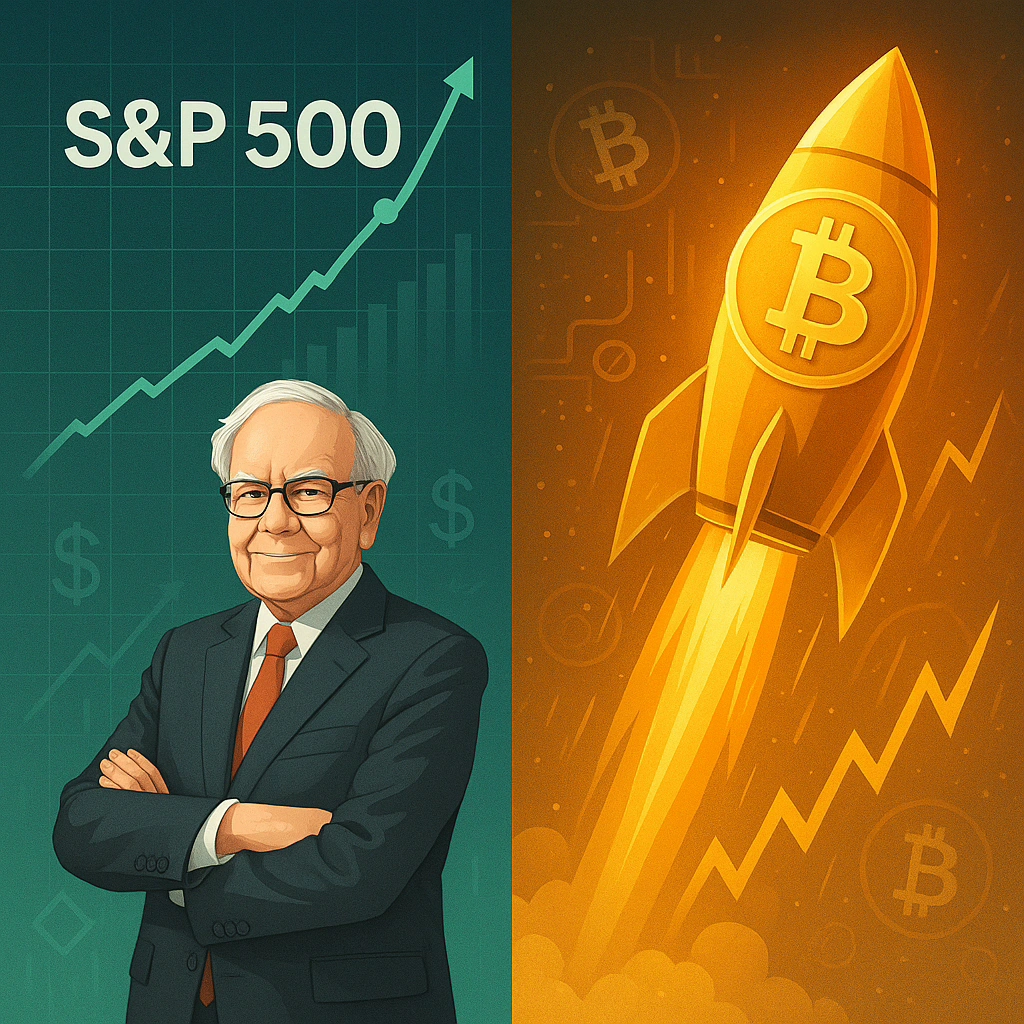
Even though Warren Buffett has long endorsed the S&P 500 as a prime investment vehicle, recent trends show that Bitcoin has far outperformed the stock index since 2020.
Phil Rosen, co-founder of the stock market newsletter Opening Bell Daily, highlighted in an October 5 X post that while the S&P 500 has grown 106% in U.S. dollars since 2020, its value in Bitcoin terms has “plummeted” by around 88%. This comparison has sparked excitement among Bitcoin enthusiasts.
The S&P 500, which tracks 500 of the largest publicly traded companies in the U.S., has historically delivered steady returns. Since its inception in 1957, the index has averaged an annual inflation-adjusted return of about 6.7%, typically exceeding U.S. inflation rates. Buffett often recommends that everyday investors allocate 90% of their portfolio to the S&P 500 and 10% to short-term U.S. Treasury bonds.
Record-Breaking Performance Across Both Assets
In 2025, the S&P 500 continues to reach new highs, currently standing at $6,715.79—a 14.43% increase year-to-date. Bitcoin, meanwhile, has surged 32% this year, recently touching $125,000 for the first time.
For perspective, an investment of $100 in the S&P 500 at the start of 2020 would now be worth approximately $209.85, while the same $100 invested in Bitcoin would have grown to $1,473.87, according to OfficialData.org.
Comparing Apples to Oranges
Despite these figures, many analysts caution that comparing Bitcoin and the S&P 500 is not entirely fair. The S&P 500 represents a broad portfolio of established companies, providing relative stability and lower risk. Bitcoin, by contrast, is a single digital asset with a unique narrative centered on scarcity, decentralization, and deflation. Its market is far smaller—around $2.47 trillion compared to the S&P 500’s $56.7 trillion—and it experiences much higher daily volatility.
In essence, while Bitcoin offers the potential for rapid gains, it carries far more risk than the diversified and historically resilient S&P 500. Each investment serves a different purpose in a portfolio, and understanding their distinctions is key to informed financial planning.
Get the weekly commit
New blockchain deep dives every week.
