

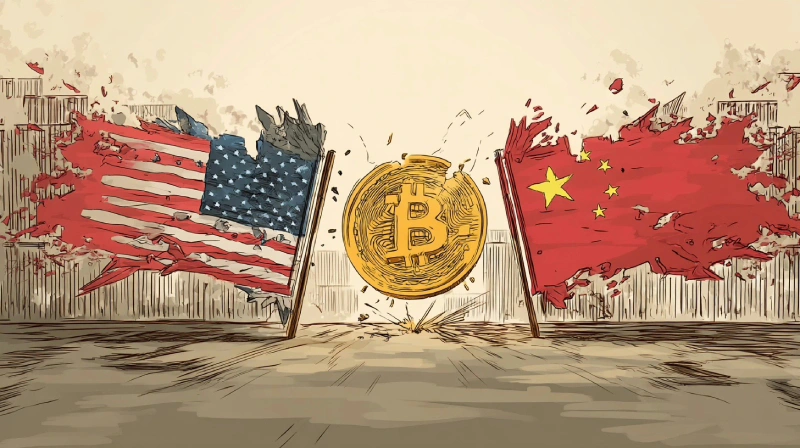
Donald Trump’s recent announcement of a “total reset” in trade relations with China has sent waves through global financial markets. U.S. Treasury Secretary Scott Bessent has stated that there has been “substantial progress” in the ongoing negotiations, raising hopes for a lessening in the long-standing trade hostilities between the two economic powerhouses.
$BTC Has outperformed stocks since "Liberation" / Tariff Day on the 2nd of April.
It held up incredibly strong during a sharp sell off on stocks in April.
It then also proceeded to outperform as the markets bounced and tariffs were implemented.
Back then people were wondering… pic.twitter.com/gfvfH80TVP
— Daan Crypto Trades (@DaanCrypto) May 11, 2025
Amid these geopolitical shifts, Bitcoin’s performance has become particularly noteworthy. In early April, the cryptocurrency saw a significant drop to $75,000, coinciding with escalating tariff threats. But by the end of the month, Bitcoin showed an amazing comeback and traded close to $95,000. This comeback has renewed debate over Bitcoin’s potential as a safe-haven asset.
While traditional safe havens like gold have long been the go-to in times of economic uncertainty, Bitcoin’s recent resilience suggests it might be carving out its own space in this arena. However, opinions on this shift remain divided. Some analysts argue that the great price swings brought on by geopolitical events highlight how volatile Bitcoin is, therefore compromising its potential as a reliable store of value. Others, however, suggest that as the cryptocurrency market matures and institutional interest grows, Bitcoin could eventually earn its place alongside traditional safe-haven assets.
As global markets keep a close eye on the developments surrounding the U.S.-China trade deal, Bitcoin’s response to these macroeconomic changes will be crucial in understanding its evolving role in the financial ecosystem.
Get the weekly commit
New blockchain deep dives every week.
