

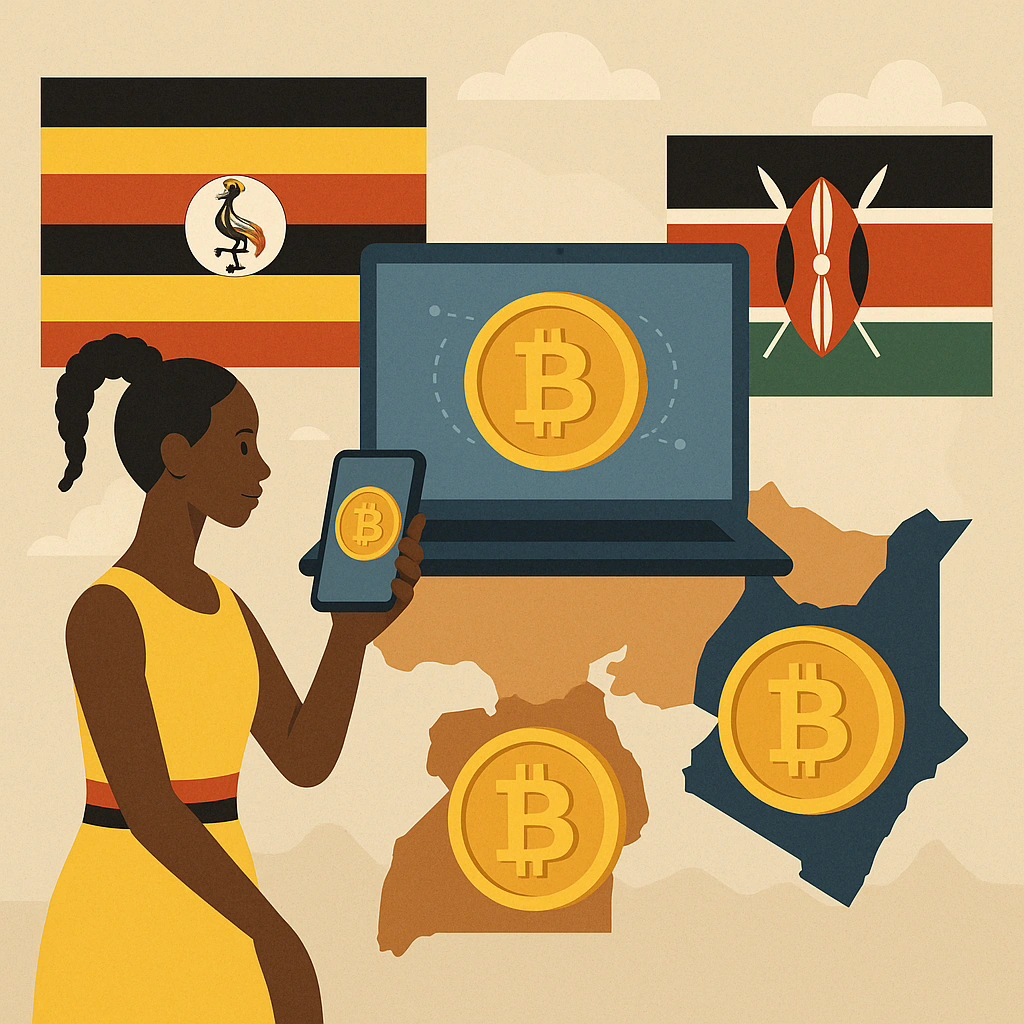
Uganda has officially launched a central bank digital currency (CBDC) pilot — marking a key milestone in its journey toward financial tokenization — while Kenya moves closer to implementing one of Africa’s most comprehensive crypto regulations.
Uganda Begins CBDC Pilot Backed by Treasury Bonds
The pilot project is being carried out in collaboration with Global Settlement Network (GSN) and Diacente Group, a Ugandan blockchain development company. The initiative is part of a broader plan to tokenize $5.5 billion worth of real-world assets, ranging from industrial infrastructure to energy projects.
Uganda’s new digital currency — a blockchain-based version of the Ugandan shilling — is hosted on GSN’s permissioned blockchain. It’s backed by Ugandan treasury bonds, ensuring value stability, and can be accessed directly via smartphone applications.
The system follows strict Know Your Customer (KYC) and Anti-Money Laundering (AML) compliance frameworks, aligning with both domestic and global financial standards.
“By combining tokenization and digital currency development, we aim to build transparent, technology-driven ecosystems that attract investment and empower local industries,” said Edgar Agaba, Chairman of Diacente Group. “This step unlocks long-term growth opportunities for our people and our region.”
Beyond the CBDC pilot, Uganda’s tokenization efforts will focus on critical economic sectors such as agriculture, mining, and renewable energy, helping digitize production and capital flows across the country.
Growing CBDC Momentum Across Africa
Uganda’s move comes as part of a growing African trend toward digital currency adoption. According to the Overseas Development Institute, Nigeria became the continent’s first nation to launch a CBDC in 2021. Ghana and South Africa are currently in the pilot stage, while Egypt has targeted 2030 for its rollout. Rwanda and Kenya remain in the research and consultation phase.
Kenya’s Crypto Regulation Bill Clears Final Parliamentary Stage
Neighboring Kenya is also making regulatory progress. The country’s Virtual Asset Service Providers (VASP) Bill, introduced in early 2025, has passed its third reading in Parliament and now awaits President William Ruto’s signature to become law.
The proposed legislation establishes a licensing and regulatory framework for exchanges, brokers, wallet providers, and token issuers. It assigns oversight responsibilities to both the Central Bank of Kenya (CBK) — which will handle custody and payment systems — and the Capital Markets Authority (CMA) — which will regulate investment and trading activities.
The bill also includes KYC and AML provisions, in compliance with the Financial Action Task Force (FATF) guidelines, and enforces advertising and consumer protection rules to prevent misleading promotions.
Africa’s Expanding Crypto Economy
The Sub-Saharan African region — which includes both Uganda and Kenya — has become one of the fastest-growing crypto markets globally. A recent Chainalysis report ranked the region third worldwide, with over $205 billion in on-chain transaction volume between July 2024 and June 2025.
By 2026, Africa’s crypto user base is expected to surpass 75 million, with total revenue projected to reach $5.1 billion, according to Statista. Stablecoins currently represent around 43% of Sub-Saharan Africa’s transaction volume, with Nigeria, South Africa, Ghana, Kenya, and Zambia leading the activity — and Uganda following close behind.
A New Era for Digital Finance in Africa
With Uganda testing its blockchain-based national currency and Kenya preparing to regulate digital assets, East Africa is rapidly emerging as a hub for blockchain innovation. Together, these developments mark a significant step toward financial inclusion, cross-border integration, and digital transformation across the continent.
Get the weekly commit
New blockchain deep dives every week.
