

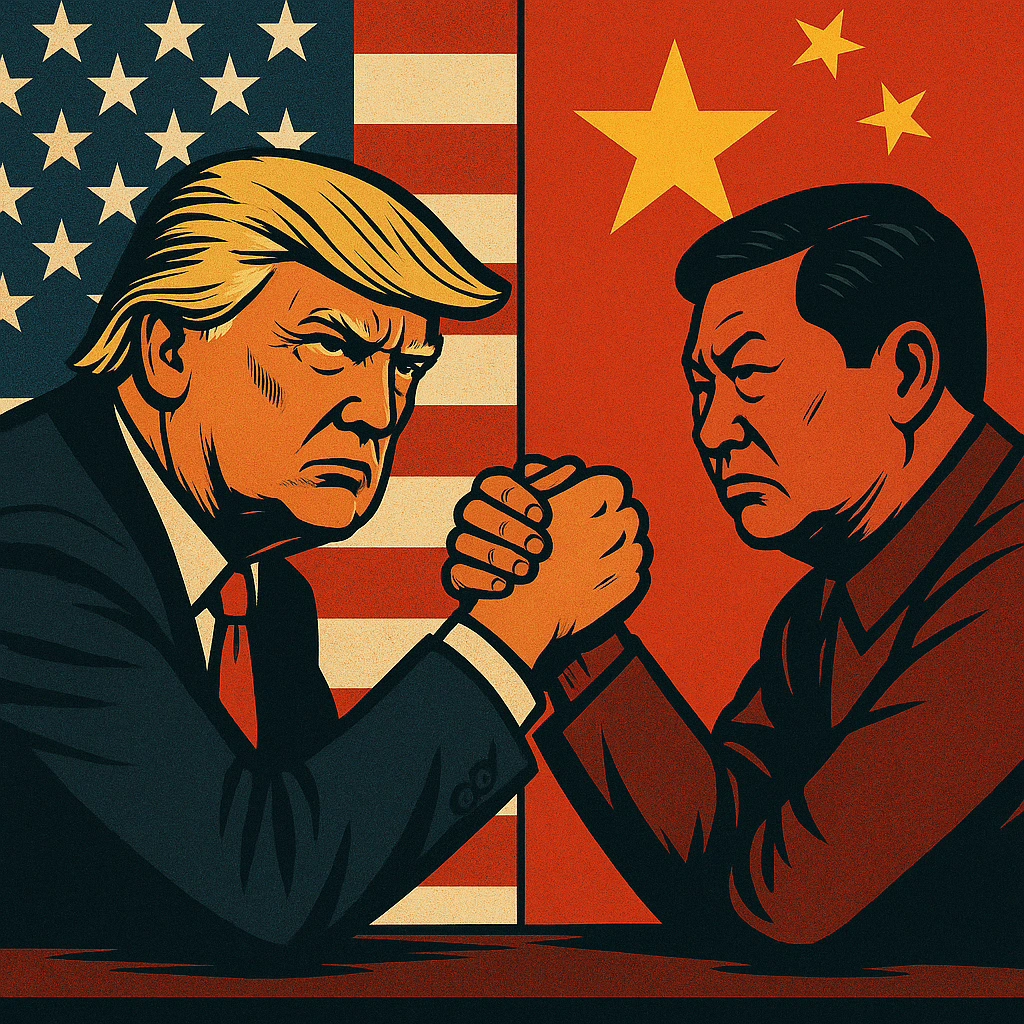
Washington D.C., Oct 15 — U.S. President Donald Trump has openly confirmed that the United States is currently engaged in a trade war with China, following his recent threat to impose 100% tariffs on all Chinese imports.
When asked by reporters whether the U.S. was preparing for a trade conflict with China, Trump responded bluntly,
“Well, we’re in one now.”
He went on to justify the tariffs as a crucial measure for national security, emphasizing that without such actions, the U.S. would be “defenseless.”
Tariff Threats Trigger Crypto Market Turbulence
Trump’s statement comes just days after his post on social media warning of sweeping tariffs against China — a move that rattled global markets. The crypto sector was hit particularly hard, with Bitcoin (BTC) plunging from around $121,560 to below $103,000 within hours of the announcement.
The President’s threat followed China’s decision to tighten export restrictions on rare earth minerals, essential components in semiconductor and chip manufacturing — a move viewed as retaliation in the ongoing trade dispute.
Although Trump’s latest comments did not lead to another sharp selloff, Bitcoin prices remain volatile, showing only a slight rebound of 0.1%, according to CoinGecko data.
Treasury Secretary Criticizes Beijing’s “Economic Coercion”
U.S. Treasury Secretary Scott Bessent also weighed in on the matter, condemning what he described as China’s “disappointing” trade behavior.
“If certain officials in Beijing want to slow the global economy through coercive tactics, it’s their economy that will suffer most,” Bessent said.
“The U.S. and its allies will not be controlled by a group of bureaucrats in China.”
His remarks highlight growing frustration in Washington over China’s export controls and broader trade policies, which many see as undermining fair global competition.
Tariffs Take a Toll on U.S. Bitcoin Mining
Beyond geopolitical tensions, the new tariffs are having a direct impact on Bitcoin mining operations in the United States.
Mining companies now face steep import duties — 57.6% on Chinese-made ASIC machines and 21.6% on devices sourced from Indonesia, Malaysia, and Thailand. The higher costs have made it significantly harder for American miners to upgrade or expand their hardware.
Last year, several U.S.-based miners also dealt with unexpected Customs and Border Protection seizures, after mining rigs were mistakenly classified as illegal radio frequency equipment.
Despite these hurdles, major Bitcoin mining firms have not relocated overseas, contrary to earlier market speculation. The industry continues to adapt while lobbying for tariff relief and clearer import policies.
What’s Next?
Trump’s acknowledgment of a full-scale trade war underscores the intensifying economic rivalry between the world’s two largest economies. With both nations tightening their trade defenses, global markets — including the crypto sector — are bracing for continued volatility.
Get the weekly commit
New blockchain deep dives every week.
