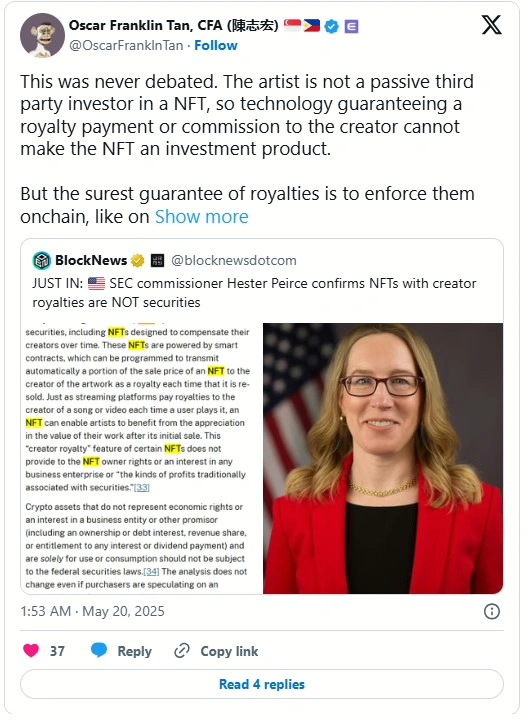

The US Securities and Exchange Commission (SEC) recently clarified that federal securities rules are unlikely to apply to many non-fungible tokens (NFTs), including those that pay royalties to inventors.
In a recent speech, Peirce said that just because an NFT includes a feature allowing artists to earn money from resales, it doesn’t mean it should be treated like a security. Unlike traditional financial assets like stocks, NFTs are programmable and can be designed to automatically share a portion of future sales with the original creators. Peirce compared this to how streaming services pay royalties to musicians and filmmakers when their content is played.
“Just as streaming platforms pay royalties each time a song or video is streamed, NFTs can be designed to reward artists when their work gains value and changes hands,” she said.
Importantly, she added that these types of royalty features don’t give NFT holders any rights to profits or ownership in a business, traits typically associated with securities.
Misinterpretations Around NFT Royalties
Oscar Franklin Tan, chief legal officer at Enjin contributor Atlas Development Services, said that Pierce’s comments have been misinterpreted in some media coverage. According to Tan, the key takeaway is that paying artists through NFT royalties isn’t new or controversial—it was never considered to be within the SEC’s jurisdiction in the first place.
“She simply reiterated a long-standing view: sending royalties back to the creator after resale doesn’t make an NFT a security,” Tan explained. “But unfortunately, some headlines made it sound like a big reversal or new decision.”
He pointed out that U.S. securities laws are meant to regulate investments, not how artists or developers get paid for their work. Royalty income, in this case, is seen more like regular business earnings than investment income, which is outside the SEC’s regulatory scope.
Tan did acknowledge, however, that things get more complex when NFTs promise profit-sharing with multiple holders. That kind of structure could raise red flags under securities laws.
His advice for regulators and companies? Apply common sense. “Ask yourself: If this were done using paper contracts instead of blockchain, would it raise the same legal concerns? If not, maybe we ought to back off,” he said.