

B
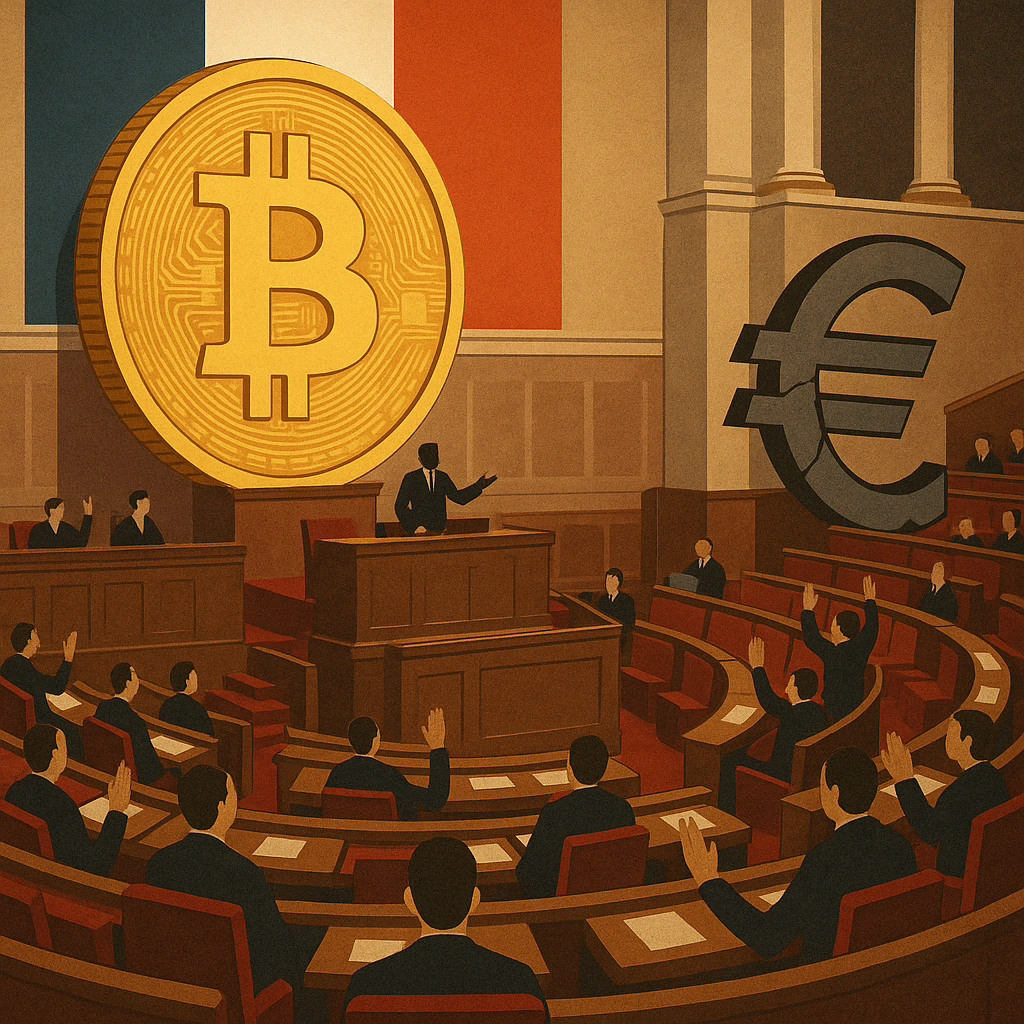
In a landmark decision that could alter the trajectory of European finance, France’s National Assembly has passed a resolution rejecting the European Central Bank’s (ECB) plan for a digital euro, instead voicing strong support for Bitcoin and euro-based stablecoins.
The initiative, introduced on October 22, 2025 by Éric Ciotti and fellow members of the Union of the Right for the Republic (UDR), urges the French government to refuse the European Commission’s proposal for a central bank digital currency (CBDC). Lawmakers argue that a digital euro would erode personal privacy and transfer excessive control to central authorities.
“A Stand for Financial Freedom”
The resolution, titled “Proposal for a European Resolution Calling for Support for the Transformation of the Monetary System,” warns that centralized digital currencies could give governments the power to monitor or even freeze citizens’ funds—threatening individual liberty.
Éric Ciotti described the vote as “a step toward defending fundamental rights and ensuring France’s monetary independence in the digital age.”
The document draws parallels between the ECB’s digital euro initiative and China’s digital yuan, cautioning that such systems risk turning financial networks into tools of surveillance.
Why Lawmakers Oppose the Digital Euro
The ECB began its preparation phase for the digital euro in November 2023, expecting to conclude it by late 2025 and potentially launch the currency around 2029. However, French lawmakers fear that direct digital accounts with the ECB could trigger mass withdrawals from private banks — a potential “bank run” — consolidating financial power in one institution.
The resolution argues:
“Such concentration of authority contradicts the principles of economic freedom. The ECB’s role is not to become a commercial bank.”
France’s Pro-Bitcoin and Stablecoin Strategy
Instead of backing the digital euro, France’s lawmakers are proposing a pro-crypto national strategy focused on three pillars:
-
Establishing a National Bitcoin Reserve
- A government-managed reserve would hold 420,000 BTC (about 2% of the total Bitcoin supply) over 7–8 years.
- The goal is to create a “digital gold” reserve to diversify foreign holdings and reinforce France’s financial sovereignty.
- Funding sources could include:
- Surplus renewable energy for state mining projects
- Confiscated crypto assets from legal cases
- A small portion of savings from Livret A and LDDS accounts
The proposal even suggests allowing tax payments in Bitcoin, pending constitutional approval.
-
Promoting Euro-Denominated Stablecoins
- Lawmakers argue that Europe relies too heavily on U.S.-based stablecoins like Tether (USDT) and USD Coin (USDC), which together represent 91% of the $230 billion global stablecoin market.
- In contrast, euro-backed stablecoins account for only $259 million in circulation.
- France’s proposal calls for a revision of the MiCA regulation to make it easier for European firms to issue euro-based tokens.
-
Supporting Crypto-Backed Financial Innovation
- The motion urges regulators to relax the Basel capital requirements, which classify crypto-collateralized loans as high risk.
- Lawmakers want a “targeted deviation” to encourage banks to engage in crypto-based lending.
A Turning Point for France’s Crypto Industry
This decision comes as France solidifies its position as a European crypto hub. The Autorité des Marchés Financiers (AMF) recently authorized Hexarq, a subsidiary of BPCE Bank, to provide crypto custody and trading services. Meanwhile, the Lightning Stock Exchange (Lise)—France’s first fully tokenized equity platform—launched under the EU’s Distributed Ledger Technology Pilot Regime.
French regulators, however, continue tightening oversight. The ACPR (Prudential Supervision Authority) has been conducting anti–money laundering inspections across exchanges such as Binance and Coinhouse in preparation for full MiCA compliance by 2026.
France’s Message to Europe
France’s pro-Bitcoin pivot underscores growing tension between national sovereignty and centralized monetary policy within the EU. Ciotti and his colleagues view decentralized assets not as a threat—but as a strategic opportunity.
“Europe must not become dependent on non-European digital currencies,” said François Villeroy de Galhau, Governor of the Banque de France, earlier this month. “Stable, euro-based alternatives are essential for our economic autonomy.”
With this vote, France signals a clear intent to pursue financial independence in the age of digital money—potentially reshaping Europe’s monetary future.
Get the weekly commit
New blockchain deep dives every week.
