


Decentralized finance (DeFi) is a new financial system based on secure distributed ledgers similar to those used by cryptocurrencies. The method deprives banks and financial institutions of control over money, financial goods, and financial services.
The cryptocurrency revolution is one of the most recent and advanced technological trends in history. As a result, new industries such as bitcoin investing, and decentralized exchanges (DEXs) have emerged. Decentralized Finance is a new industry that is gaining popularity in the blockchain environment. The DeFi financial system will allow anyone with an internet connection to invest in projects.
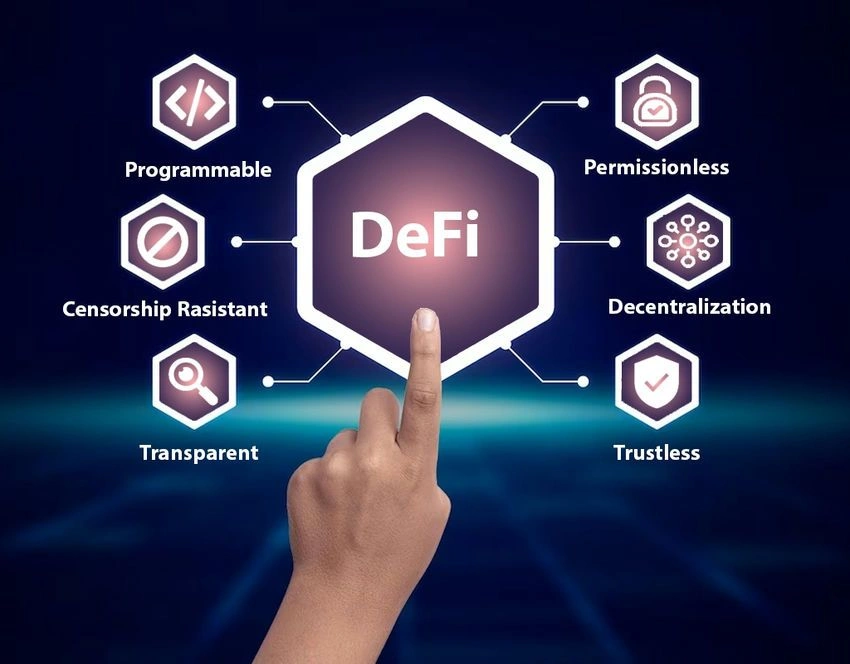
Decentralized finance (DeFi)
DeFi charges lower fees than traditional banks. Many people have even taken out and returned multi-million dollar loans without providing any form of identification.
Furthermore, DeFi operates without the use of traditional, centralized intermediaries. It can be transmitted through transactions between two parties without the use of any intermediaries (banks), making detection and control difficult for governments or other third parties. This enables cryptocurrency users to send money between parties while remaining anonymous.
How does DeFi work?
DeFi provides financial services through the use of cryptocurrencies and smart contracts, removing the need for intermediaries such as guarantors. Services such as lending (where users can lend their cryptocurrency and earn interest in minutes rather than once a month), instant loans, peer-to-peer trading without a broker, cryptocurrency savings, and better interest rates accrued. Banks buy commodities such as futures contracts and stock options.
Users use dApps to conduct peer-to-peer business transactions, with the vast majority of these apps residing on the Ethereum network. Coins (Ether, Polkadot, Solana), stablecoins (whose value is linked to a currency like the US Dollar), tokens, digital wallets (like Coinbase and MetaMask), DeFi mining (also known as liquidity mining), yield farming, staking, trading, and smart contract-based borrowing, lending, and saving are some of the more well-known DeFi services and dApps.
Because DeFi is open source, users can theoretically observe and innovate on the protocol and app. As a result, users may combine different protocols to open up new possibilities by creating their own dApps.
Difference between DeFi vs. Traditional Finance
| Factors | DeFi | TRADITIONAL FINANCE |
|---|---|---|
| Governance and Control | Decentralized Finance operates on blockchain technology, allowing for decentralized governance. Decision-making is often community-driven, with participants having a say in the development and evolution of the platform through voting and consensus mechanisms. | Centralized financial systems are governed by regulatory authorities, central banks, and financial institutions. They set rules, regulations, and policies that dictate the functioning of the financial ecosystem. |
| Accessibility | DeFi aims to provide open and inclusive financial services to anyone with an internet connection. It removes barriers to entry, enabling individuals worldwide to access financial products and services without relying on traditional intermediaries. | Access to Traditional Finance is often limited by geographic location, financial status, and regulatory requirements. Certain financial services and products may be inaccessible to individuals who do not meet specific criteria or have a formal banking relationship. |
| Intermediaries and Middlemen | DeFi eliminates many intermediaries by leveraging blockchain technology and smart contracts. Transactions are conducted directly between participants, reducing the need for intermediaries and streamlining processes. This can lead to cost savings and increased efficiency. | Traditional financial systems heavily rely on intermediaries such as banks, brokers, and payment processors. These intermediaries facilitate transactions, enforce regulations, and provide services. However, they can introduce additional costs, delays, and complexities to the financial ecosystem. |
| Transparency and Security | DeFi operates on public blockchain networks, offering a high level of transparency. Transactions and smart contract codes are visible on the blockchain, enabling anyone to verify and audit the system. Security is enforced through cryptographic algorithms, consensus mechanisms, and decentralized infrastructure. | Transparency in Traditional Finance can vary, with financial institutions having control over user data and transaction details. Security is enforced through regulatory frameworks, compliance measures, and centralized security systems. |
| Innovation and Flexibility | DeFi fosters rapid innovation and experimentation. Being built on blockchain technology, it enables developers to create and deploy new financial instruments and protocols with relative ease. This promotes a dynamic ecosystem where new ideas can be implemented quickly. | Traditional financial systems are often characterized by slow innovation cycles and limited flexibility due to regulatory constraints and legacy infrastructure. Implementing new features or products can be time-consuming and complex. |
Benefits of Decentralized Finance
The following crucial factor in comprehending decentralized finance is that DeFi makes reference to its benefits. Let’s concentrate on the crucial points that support the growing acceptability of DeFi despite the fact that the practice provides numerous advantages.
Security: The creation of a new architecture that minimizes single points of failure and relies less on middlemen is the first step toward a successful blockchain implementation. This is suitable for financial transactions as the blockchain will ensure that third-party middlemen cannot misuse, abuse, or otherwise meddle with consumers’ money. It increases users’ trust in the platforms.
Transparency: Blockchain technology creates a single common source for all network members and standardizes common activities. Any blockchain platform’s transactions are forever recorded and may be checked and verified.
Programmability: By enabling the design and execution of smart contracts, blockchain technology enables the secure automation of corporate activities.
Non-custodial: Because these business procedures won’t require their assistance, third-party custodians become redundant. It is feasible to save money using this technique.
Democratization: You have access to it regardless of where you are or who is in charge. Users don’t even need to be able to connect to the Internet. Blockchain technology will enable people to engage in the financial system in the framework of DeFi without opening a conventional bank account.
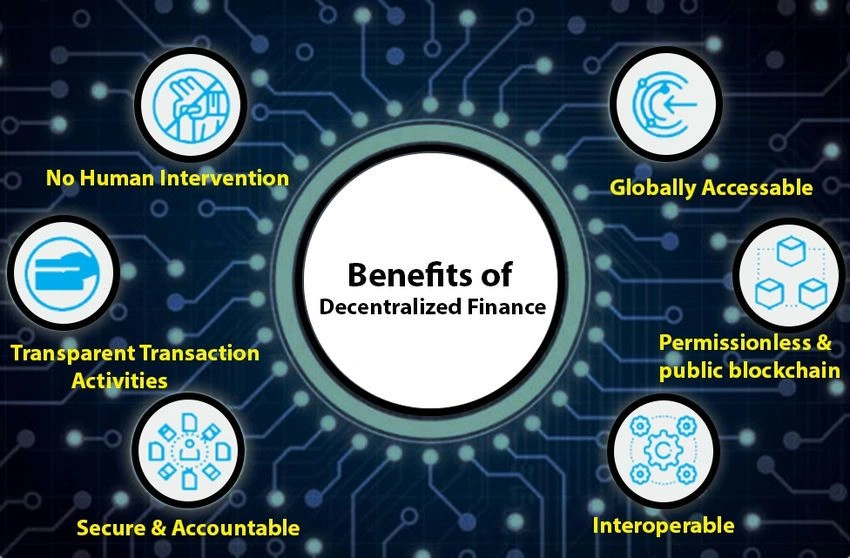
Benefits of Decentralized Finance
Challenges and Risks of DeFi
Security Risks: While blockchain technology provides inherent security, DeFi applications are not immune to risks. Smart contract vulnerabilities and hacking attacks can result in financial loss. It is essential for users to exercise caution and conduct thorough research before engaging with DeFi platforms.
Regulatory Uncertainty: DeFi operates in a regulatory gray area, and its rapid growth has attracted attention from regulators worldwide. As the industry matures, regulatory frameworks are likely to evolve, posing potential challenges and compliance requirements for DeFi platforms.
Scalability: Blockchain networks face scalability challenges, and as DeFi applications gain popularity, they can strain network capacity and lead to higher transaction fees and slower confirmation times. Solutions like layer-2 protocols and blockchain interoperability aim to address scalability concerns.
Conclusion
Decentralized Finance (DeFi) is a paradigm-shifting change in the financial industry. DeFi seeks to build an accessible, transparent, and secure financial environment by utilizing blockchain technology and smart contracts. Although it offers many advantages, including better interoperability and financial inclusion, there are still issues that must be resolved before it can be widely used in terms of security, legislation, user experience, and scalability. The financial sector might change as a result of the DeFi space’s continued development, providing people with more financial freedom and encouraging financial services innovation.
FAQs
Q. My money is secure with DeFi.
A. DeFi protocols use encryption and smart contracts to increase security. However, hazards might still exist due to flaws in decentralized apps or smart contracts. Due diligence, reviewing audits, and using trusted platforms is crucial.
Q. How can I begin using DeFi?
A. Create a digital wallet, such as a MetaMask wallet, then link it to a decentralized exchange (DEX) or lending site to get started with DeFi. After that, you may start interacting with different DeFi protocols and exploring them.
Q. DeFi regulated?
A. The environment in which DeFi works is not very controlled. DeFi’s ecosystem as a whole is still largely unregulated, despite the fact that several governments have implemented rules for specific components of the technology. Before interacting with DeFi platforms, users should be informed of any possible hazards and exercise caution.
Q. DeFi systems are they safe?
A. Though DeFi platforms are not immune to threats, blockchain technology does have built-in security safeguards. There have been security lapses in the DeFi industry, including smart contract flaws and hacker instances. It’s imperative that users take caution, follow security best practices, and thoroughly consider the dangers connected to each site.
Get the weekly commit
New blockchain deep dives every week.
