

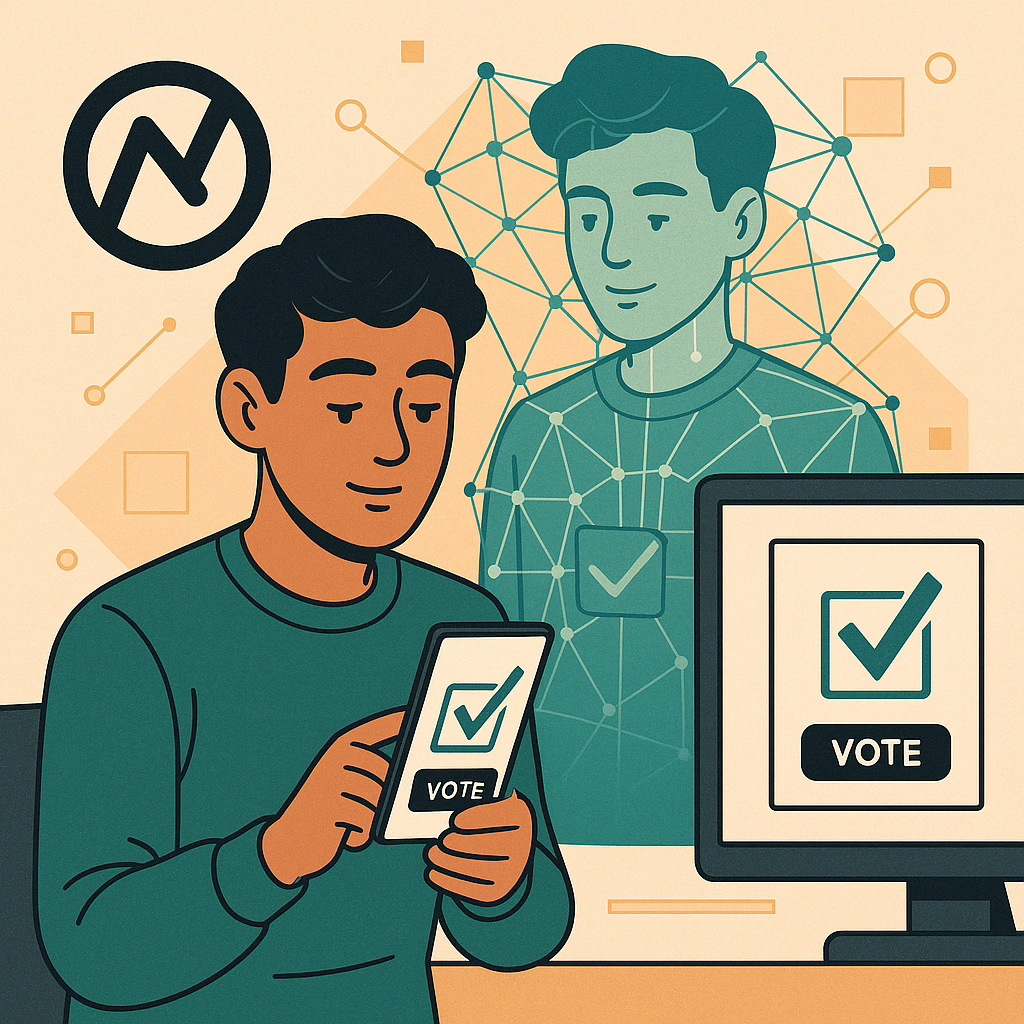
The Near Foundation is working on an ambitious project to solve one of the biggest challenges facing decentralized organizations: low voter participation. The team is developing AI-powered “delegates” — also called digital twins — that could eventually cast governance votes on behalf of members of the Near Protocol’s DAO.
Tackling Voter Apathy in DAOs
Most decentralized autonomous organizations (DAOs) struggle with engagement, with only 15–25% of token holders typically voting. This opens the door to power imbalances, poor decision-making, or even malicious governance takeovers.
According to Lane Rettig, a researcher at Near specializing in AI and governance, these new digital twins would be trained to understand a user’s preferences and then vote in alignment with them. “You set it up, and it acts for you,” Rettig explained during TOKEN2049 in Singapore. Proposals relevant to a user would be flagged, and the AI would handle the rest, speeding up the entire process.
A Human Still in the Loop
Despite the automation, Rettig stressed that certain decisions — such as major funding choices or big strategic changes — should still be left to people. “AI can guide and suggest, but there are critical moments where a human must give the final approval,” he said.
How the AI Delegates Learn
Much like large language models, the AI agents will be trained through direct interactions: interviews with users, analysis of their past voting records, and even online activity in communities like Telegram or Discord. Over time, the AI would build a clear profile of a member’s priorities and values.
To ensure transparency and trust, Near is exploring cryptographic proof of training cycles, so users can verify that the delegate has been aligned with their actual inputs.
Step-by-Step Rollout
The AI delegate program won’t be rolled out overnight. The roadmap starts with basic chatbot-style tools that simply provide context and recommendations. Later, the system will scale to represent groups of members with similar preferences, and eventually, each DAO participant could have their own personalized AI twin.
In the long run, Near envisions governance becoming almost instant — since the system would already know how delegates will vote, tallying up results would be “just a math problem.”
The Bigger Picture
The Near Digital Collective, the foundation’s main DAO, has already introduced AI-driven tools like Pulse, which tracks community sentiment and condenses discussions from platforms like Discord. Expanding into AI delegates is the next step.
Industry observers note that AI agents in crypto are already becoming common, with applications in trading, dApp interaction, and protocol management. Analysts like VanEck estimate the number of AI agents in Web3 could grow from 10,000 in 2024 to over a million by 2025.
Still, concerns remain — over both security risks and the possibility of AI making poor judgment calls. That’s why Near is taking a gradual approach, blending AI efficiency with human oversight.
If successful, this system could reshape how DAOs govern themselves, potentially turning voting from a slow, manual process into something almost seamless.
Get the weekly commit
New blockchain deep dives every week.
